

Table of Contents
- What to Look for in an Indoor Gardening Kit
- Indoor Gardening Kits for Beginners
- Best Indoor Herb Gardens
- Indoor Hydroponic Systems That Deliver Results
- Indoor Gardening Kits for Vegetables
- Operating Costs and Long-Term Value
- Which Indoor Gardening Kit Should You Choose?
- Frequently Asked Questions
Last Updated: October 21, 2026
What to Look for in an Indoor Gardening Kit
Choosing the right indoor gardening kit depends on your space, skill level, and what you want to grow. The best systems balance ease of use, capacity, and long-term operating costs.
Start by considering these core factors:
Growing capacity matters more than you'd think. A 6-pod kit feels limiting after your first harvest, so plan for expansion or buy larger upfront.
Light quality directly affects growth speed and plant health. LED grow lights come in different wavelengths, full-spectrum lights support most plants, while herb-specific lights optimize for leafy greens and culinary herbs. The USDA's guide to indoor plant lighting explains how light intensity and duration influence germination and growth rates.

Water management separates systems that stay clean from those that breed algae and mold. Check for a watering timer, which prevents overwatering.
Growing medium compatibility affects your long-term costs. Some kits lock you into proprietary seed pods at premium prices. Others accept standard seed starting media, giving you flexibility to source seeds from Garden Gets or elsewhere.
Noise and reliability matter if the kit sits in your kitchen or bedroom. Pump-driven hydroponic systems can be audible; passive systems (wick-based or capillary mat) run silently.
At Garden Gets, we stock the components to build or enhance your indoor gardening setup. Our LED Flexible Grow Light pairs with any kit for supplemental lighting, and our seed collections give you full control over what you grow.
Indoor Gardening Kits for Beginners
Start small and learn the basics before investing in complex systems. Beginner-friendly indoor gardening kits prioritize simplicity over capacity.
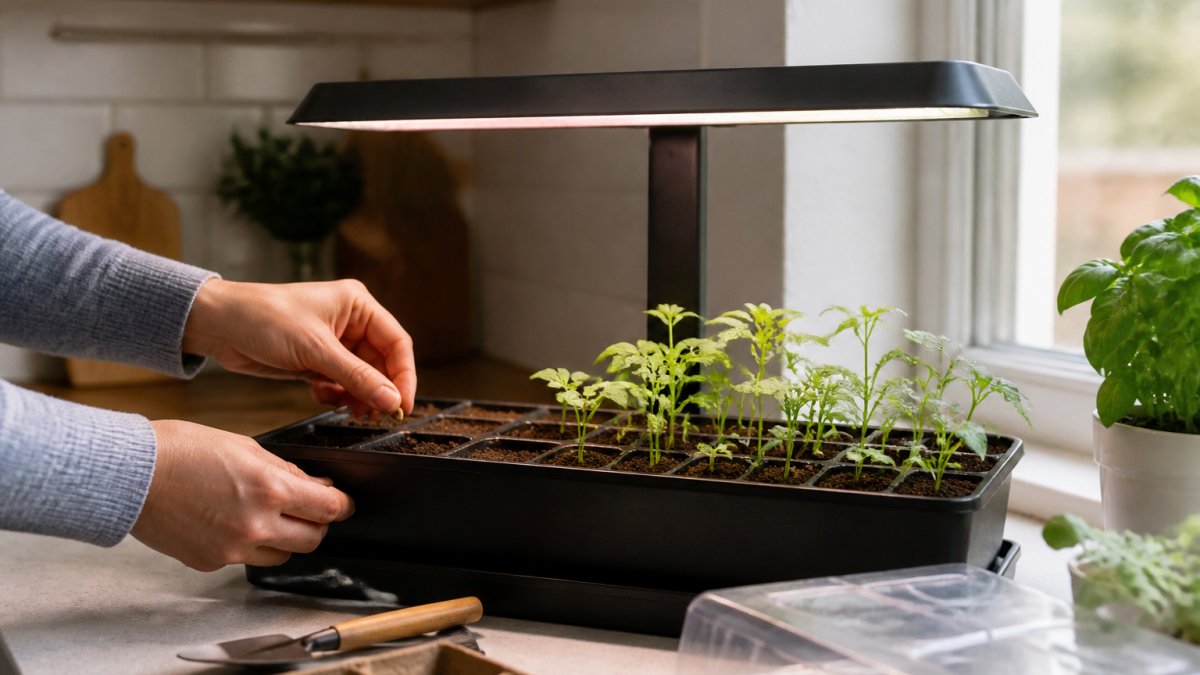
The ideal beginner system has pre-planted pods or easy-to-fill slots, automatic or simple watering, built-in lighting, and a footprint under 12 inches wide.
A single system fits on a windowsill, desk, or kitchen counter.
Water reservoirs should be transparent so you can see the level at a glance.
Nutrient solutions for beginners should be pre-mixed or come in measured packets. Avoid kits that require calculating pH or measuring nutrient concentrations by hand.
Our Beginner Vegetable Seed Collection - 10 Varieties pairs well with any starter kit. It includes 10 proven easy-to-grow varieties like lettuce, radishes, and green beans.

Best Indoor Herb Gardens
Fresh herbs year-round are a great option. Indoor herb gardens deliver continuous harvests in small spaces.
Herb-specific systems optimize for leafy growth rather than fruiting.
The best herbs for indoor growing are those you use constantly: basil, chives, parsley, cilantro, and mint. These tolerate variable light and forgive occasional watering lapses.
Chives deserve special mention. Our Chives - 100 Seeds packet includes heirloom, open-pollinated seeds that produce hardy perennial plants. Chives regrow after cutting and produce edible purple flowers in late spring. Plant them once and harvest for years.
For serious herb gardeners, our Zebrune Shallot Seeds offer gourmet flavor in a compact plant. These heirloom shallots mature in 100-120 days and store for months after harvest. They're technically a bulb, not an herb, but they thrive indoors under lights and add sophistication to your kitchen garden.
Indoor Hydroponic Systems That Deliver Results
Hydroponic systems can grow plants faster than soil because nutrients reach roots instantly.
Hydroponic indoor gardening kits use water, not growing medium, to support roots. Nutrients dissolve directly in the water, so plants absorb what they need immediately, cutting growing time and reducing waste.
Three hydroponic designs dominate the home market: deep water culture (DWC), nutrient film technique (NFT), and ebb-and-flow. DWC is simplest, roots sit in oxygenated water kept alive by an air pump.
For beginners, DWC is forgiving, fewer moving parts. NFT systems are quieter. Ebb-and-flow offers the largest capacity.
Expect to change water every 2-3 weeks in a DWC system. This prevents nutrient imbalances and algae blooms. The Cornell University's guide to hydroponic nutrient management details how to monitor pH and EC (electrical conductivity) to keep plants healthy.
Indoor Gardening Kits for Vegetables
Growing vegetables indoors is a different job from growing herbs. Vegetables need more light, root space, and nutrients, and the payoff depends heavily on crop choice. Below separates crops that realistically work in a countertop kit from those needing a larger system.
Light Is the Limiting Factor
Most vegetables need 12-16 hours of quality light daily. A sunny windowsill is rarely enough except in very bright climates, and even then light is seasonal. A full-spectrum LED grow light can make a difference for harvestable plants. Position it 6-12 inches above the canopy and raise it as plants grow. Leafy greens are forgiving; fruiting crops less so.
Leafy Greens: The Reliable Indoor Crop
Lettuce, spinach, arugula, kale, and Swiss chard are the best vegetables for indoor kits. They mature in roughly 30-45 days, tolerate crowding, and can be harvested leaf-by-leaf. In hydroponics, space them 4-6 inches apart, in a 6-9 pod kit, one plant per pod with selective harvesting rather than waiting for a full head. Loose-leaf lettuce can be more forgiving than head lettuce indoors.
Radishes and Quick Roots
Radishes are a fast vegetable payoff, often ready in 25-30 days. They need a slightly deeper growing medium than lettuce, so check that your kit's pods or net cups accommodate root development. Round varieties can work well indoors. Carrots are possible bu
Operating Costs and Long-Term Value
The sticker price of an indoor gardening kit is only the entry fee. Real ownership cost is electricity, replacement media, nutrients, seeds, and filters spread across a year.
Electricity
LED grow lights are the largest recurring cost. A countertop kit draws 10-30 watts; a multi-tier system 60-150 watts. Run the math on your rate: watts × hours per day ÷ 1,000 × cents-per-kWh × 365. At roughly 15-20 cents per kWh, a 20-watt light running 14 hours a day costs about $1.50-$2.00 per month; a 100-watt system running 16 hours costs roughly $7-$12. Pumps are negligible, but a heated propagator or dehumidifier can quietly double the bill. Check label wattage, not the marketing "equivalent" figure.
Growing Media and Refills
This is where kit design matters most. Proprietary seed pods often cost $1-$3 each and must be replaced every crop; a 9-pod kit replanted four times a year runs $36-$108 annually. Open systems accepting loose coco coir, peat, rockwool, or reusable clay pebbles can cost less, a bag of coco coir or box of rockwool often covers dozens of plantings for $15-$30, and reusable media can last multiple seasons with cleaning. If a kit only accepts its own pods, treat refill cost as part of the purchase price.
Nutrients
Hydroponic nutrients typically run $10-$25 per bottle, with two-part sets common. A small herb system may use a bottle every 3-4 months; a larger vegetable reservoir every 4-8 weeks. Budget roughly $5-$15 per month for a small kit and $15-$30 for a large one. Soil-based kits using pre-charged media or slow-release fertilizer cost less in nutrients but more in replacement media.
Seeds
Seeds are an affordable input if you buy open-pollinated or standard packets, a $2-$4 packet of lettuce or basil supplies multiple plantings. Proprietary pod systems hide this cost inside the pod price. For continuous growing, standard packets started in loose media can be cheaper than pre-seeded pods.
Filters and Replacement Parts
Some kits include a carbon or particulate filter, air stone, or pump diaphragm that wears out. Replacement filters commonly run $5-$15 and may need changing every 2-4 months; air stones and pump parts are cheap but easy to forget. Add $20-$60 per year for a typical pump-driven kit, and check whether the manufacturer sells replacement parts.
A Rough Annual Budget
For a single countertop hydroponic kit growing herbs and lettuce, a realistic annual budget is roughly $60-$150 for electricity, $20-$60 for nutrients, $20-$100 for media or pods, and $10-$40 for seeds and small parts, call it $110-$350 per year depending on kit design and local rates. A large multi-tier system can easily exceed that. These are planning ranges, not quotes.
Cost and Yield Versus Store-Bought Produce
A head of lettuce at retail commonly costs $2-$4, and a small bunch of fresh basil $2-$4. A productive countertop system can yield several heads of lettuce or repeated herb cuttings per month once established. If a kit costs $100-$200 and runs $10-$25 per month, break-even against store-bought produce can be in the first 6-18 months for herbs and leafy greens, faster for higher-value crops like basil, slower for cheap crops like radishes. Fruiting crops such as tomatoes and peppers take longer because of light and space requirements. The honest framing: indoor kits can be economical for herbs, microgreens, and out-of-season produce, and the non-financial payoff, freshness, variety, and control, is real.
Which Indoor Gardening Kit Should You Choose?
Match your choice to your actual habits, not your aspirations.
If you forget to water, choose a hydroponic system with automatic watering. If you travel frequently, pick a kit with large reservoirs so you can skip watering for a week. In a small apartment, prioritize vertical systems or compact countertop designs.
Budget matters. Spend $50-150 on a decent system with good lighting and reliable water delivery. Pair it with quality seeds from Garden Gets.
Start with one system, not three. Learn how it works, harvest your first crop, then expand.
Visit Garden Gets to source everything you need: seeds, grow lights, tools, and watering systems. Our 13Pcs Garden Tool Set at $56.99 includes pruning shears and soil tools for transplanting seedlings. Our Efficient Drip Irrigation Kit at $42.99 automates watering for larger setups.

The best indoor gardening kit is the one you'll actually use. Choose systems that match your space and commitment level, stock them with seeds you're excited to grow, and commit to learning the basics.
Frequently Asked Questions
What is the best indoor gardening kit for beginners?
Start with a kit that includes seeds, grow lights, and simple instructions. The Beginner Vegetable Seed Collection ($14.99) paired with an LED Flexible Grow Light ($10.99) gives you everything needed to understand seed starting and plant growth cycles. These components work together without complex assembly, making them ideal for learning the basics before investing in larger systems.
How much does it cost to run an indoor hydroponic system?
Operating costs depend on electricity use for grow lights and water replacement. An LED Flexible Grow Light at $10.99 uses minimal power compared to traditional bulbs. Seed costs are low (Chives at $1.99 for 100 seeds, Zebrune Shallots at $3.99), so total monthly expense stays under $50 for small-scale indoor gardens.
What can you grow in an indoor gardening kit?
Indoor kits work well for fast-growing crops: leafy greens (lettuce, spinach), herbs (chives, basil), microgreens, and some vegetables (peppers, tomatoes, beans). The Beginner Vegetable Seed Collection includes 10 varieties that can succeed indoors with proper lighting. Herbs like chives mature in 60-90 days and produce continuous harvests through cutting. Avoid long-season crops like winter squash unless your setup has significant vertical space.
Do I need special lighting for indoor gardening?
Yes. Indoor spaces rarely provide enough light for edible plants. An LED Flexible Grow Light ($10.99) provides plant-specific wavelengths that encourage growth. Position lights 6-12 inches above seedlings and adjust height as plants grow. LED lights are water-resistant and energy-efficient, making them practical for kitchen counters or shelves. Without adequate lighting, seedlings become weak and leggy.
How much space do indoor gardening kits need?
Small kits fit on a kitchen counter or shelf (12-24 inches wide). Vertical systems stack multiple growing levels to maximize yield in minimal floor space. A drip irrigation kit covers approximately 161-215 square feet depending on your nozzle layout, so you can scale from a single windowsill to an entire room. Most apartment-friendly setups require less than 2 square feet of counter space.
Ready to grow fresh food indoors? Shop our complete selection of seeds, grow lights, and gardening tools at Garden Gets. We carry everything from beginner seed collections to professional-grade hydroponic components. Start your indoor garden today and harvest fresh herbs and vegetables within weeks.