

Table of Contents
- What Makes Heirloom Vegetable Seeds Worth Buying
- Price and Shipping Comparison: What You Actually Pay
- How to Vet the Best Heirloom Seed Companies
- Where to Find Organic Heirloom Seeds
- Heirloom Seed Catalogs: What to Expect in 2026
- Free Heirloom Seeds: Legitimate Sources and What to Watch For
- Matching Heirloom Vegetable Seeds to Your Garden and Climate
- Frequently Asked Questions
Last Updated: October 16, 2026
What Makes Heirloom Vegetable Seeds Worth Buying
Heirloom vegetable seeds are open-pollinated varieties passed down through generations, and they remain the most reliable way to grow food that tastes like something. At Garden Gets, we hear the same question every spring: where to buy heirloom vegetable seeds without gambling on germination rates or overpaying.
The short answer: buy from a seller that publishes germination testing, states the variety type on the packet, and ships seeds in resealable, recyclable packaging. A packet that says "heirloom" but not "open-pollinated" is telling you half a story.
Heirloom vs. Hybrid: What the Label Doesn't Tell You
The difference shows up in your second season: saved heirloom seed gives you the same plant again, while hybrid offspring revert, often producing something smaller, bitter, or sterile.
That matters for flavor: commercial hybrids are selected for how well they survive a truck, not how they taste. Varieties like Jimmy Nardello's pepper survived because cooks kept growing them.

One caveat: heirlooms are not automatically disease-resistant. If your region has heavy disease pressure, check variety notes before committing a whole bed.
Price and Shipping Comparison: What You Actually Pay
Seed pricing is where most buyers get quietly overcharged. The packet price is rarely the real cost, because shipping and order minimums decide what lands on your card. A $2.99 packet with $6.95 shipping costs more than a $4.49 packet that ships free.
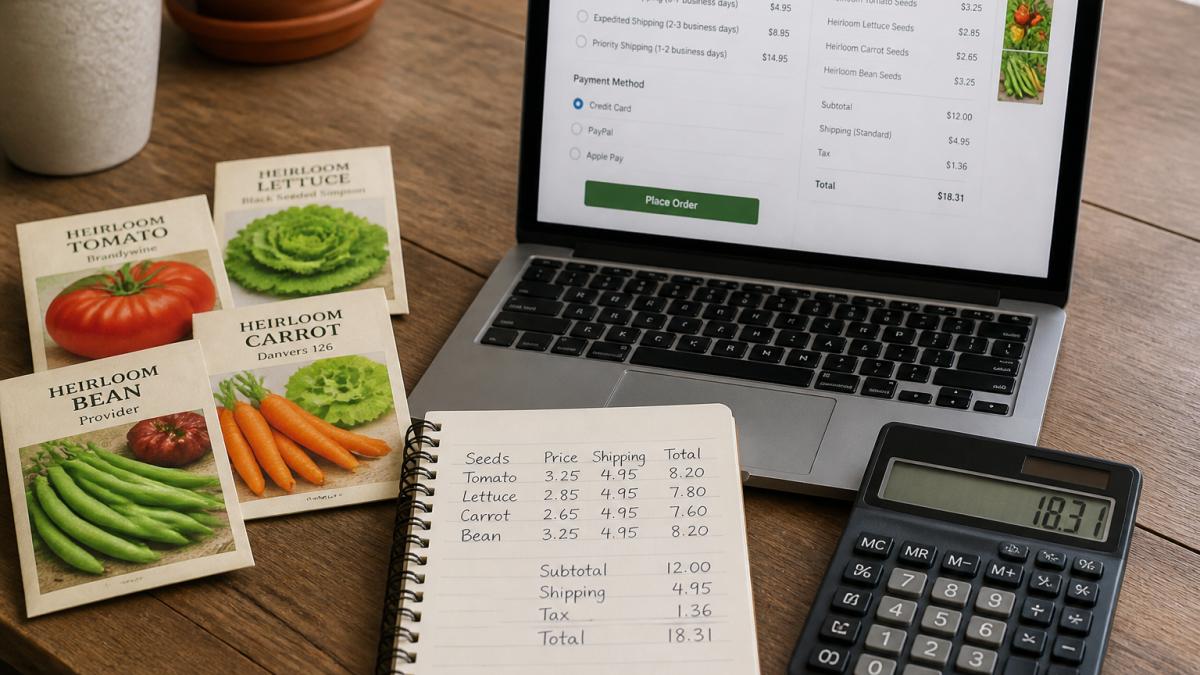
The Four Numbers That Decide Your Real Cost
Before you compare any two sellers, pull these four figures from each checkout page:
- Packet price, the sticker price per variety.
- Seed count, the approximate number of seeds, not the packet weight.
- Shipping cost, flat rate, weight-based, or free above a threshold.
- Order minimum, the smallest order the seller will accept.
Divide packet price by seed count to get cost per seed. That single number exposes the packets that look cheap and are not.
Cost Per Seed: A Worked Example
Two packets, same crop, very different value:
| Packet | Seeds | Price | Cost Per Seed |
|---|---|---|---|
| Economy carrot packet | 100 | $1.99 | $0.0199 |
| Premium carrot packet | 500 | $4.49 | $0.0090 |
The premium packet costs twice as much at the register and less than half as much per seed. If you are planting more than a short row, the higher sticker price is the cheaper seed.
How Shipping Changes the Math
Shipping is where small orders lose. Sellers commonly charge a flat $4 to $6 with free shipping above a threshold, often $25 to $50. Three separate $5 orders can cost more in shipping than one $15 order that crosses the free-shipping line.
Order Minimums and Regional Limits
Some sellers enforce a minimum order, and a few restrict which states they ship certain varieties to under state agriculture rules. Check the shipping policy page before you fill a cart.
Our Own Lineup, Priced the Same Way
Here is how our packets break down, using the same four numbers:
| Seed Packet | Varieties Included | Price | Shipping Threshold |
|---|---|---|---|
| Beginner Vegetable Seed Collection | 10 varieties | $14.99 | Free over $35 |
| Jimmy Nardello's Pepper | 1 variety, 25 seeds | $4.99 | Free over $35 |
| Pinto Bean | 1 variety, 20 seeds | $1.99 | Free over $35 |
| National Pickling Cucumber | 1 variety, 30 seeds | $1.99 | Free over $35 |
| Black Nebula Carrot | 1 variety, 250 seeds | $1.99 | Free over $35 |
Flat-rate shipping applies no matter how many packets you order, and tracking is included on every order.

The collection is the better deal for a first garden: ten varieties for $14.99 is roughly $1.50 per crop, and you get a complete planting rather than one lonely row of radishes.
A Comparison Template You Can Reuse
Fill one row per seller before you buy:
| Seller | Packet Price | Seed Count | Cost Per Seed | Shipping | Free-Ship Threshold | Order Minimum |
|---|---|---|---|---|---|---|
Five minutes with this table will tell you more than any "best seed companies" list.
How to Vet the Best Heirloom Seed Companies
The best heirloom seed companies name the variety precisely, test germination, label seed type honestly, and disclose where the seed was grown. Here is the checklist we would use on any supplier, including ourselves:
- Does the listing state "heirloom" and "open-pollinated"?
- Is the botanical name listed, not just a nickname?
- Is seed quantity stated as an approximate count?
- Does the seller mention germination testing?
- Is the packaging resealable for multi-year storage?
- Is the origin of the seed disclosed?
- Are growing instructions included on the packet?
A common mistake is buying on price alone and ignoring seed count: a cheap packet with 15 seeds is not cheaper than a pricier one with 250. Do the math per seed. Also consider storage, thin paper envelopes lose viability faster once opened, while resealable, recyclable packets hold up far better across seasons.
Where to Find Organic Heirloom Seeds
Organic heirloom seeds are grown under certified organic production, meaning no synthetic pesticides or fertilizers during seed production. The label describes how the seed was grown, not what the plant does in your garden.
For most home growers, non-GMO and open-pollinated matters more day to day.
Check the USDA National Organic Program if you want to understand what certification actually requires before paying extra for it.
Heirloom Seed Catalogs: What to Expect in 2026
Heirloom seed catalogs in 2026 look different from the paper books gardeners once waited for in the mail. Most sellers now run a searchable online catalog with filters for growing zone, days to maturity, and seed type. What has not changed: a catalog is a sales document, and the quality signals are buried in the fine print.
Catalog Features Worth Filtering On
Expect these features from a well-built catalog:
Beginner Vegetable Seed Collection – 10 Varieties →
- Variety filters by zone, sun needs, and days to maturity
- Clear seed counts and botanical names on each listing
- Growing instructions on the product page, not buried in a PDF
- Bundles and collections for buyers starting from scratch
The trade-off with large catalogs is decision fatigue. Hundreds of tomato varieties is not helpful to a first-time grower. Collections exist for exactly this reason: they remove the choosing problem and hand you a balanced set.
Seed Quality and Sourcing Standards: The Six Things to Check
A catalog can list 800 varieties and still sell you old, untested seed.
1. Germination rate. Germination testing tells you what percentage of seeds in a lot actually sprouted under controlled conditions.
2. Seed age and packing date. Germination declines with age, faster in warm, humid storage.
3. Open-pollinated status. "Heirloom" and "open-pollinated" are not the same claim.
**4. Check the USDA National Organic Program if you want to understand what certification actually requires before paying extra for it.
5. Untreated status. Many commercial vegetable seeds are sold treated with fungicide coatings, often dyed bright.
**6.
Returns, Guarantees, and What Happens When Seed Fails
Seed is a living product, and germination can fail for reasons nobody controls. What matters is the policy before you plant.
- Replacement policy. Many sellers replace seed that fails to germinate within a stated window, often 30 to 60 days, if you followed the packet instructions. Read the exact wording.
- Return window. Unopened packets are usually returnable within a set period, commonly 14 to 30 days. Opened packets often are not.
- Proof required. Some sellers ask for photos, a germination count, or the original order number. Know what you will need.
- Support channel. Email-only support with a multi-day response time is a different experience than phone or chat during business hours.
A Practical Sequence for a New Grower
- Check your USDA hardiness zone and average first frost date
- Pick varieties whose days to maturity fit inside your season
- Start with fast crops like radishes and lettuce for early wins
- Add one or two longer-season crops once you know your light levels
- Order resealable packets so leftovers keep for next year
The USDA Plant Hardiness Zone Map gives you the zone figure you need before ordering anything.
Free Heirloom Seeds: Legitimate Sources and What to Watch For
Free heirloom seeds exist, and some sources are genuinely useful. Seed libraries, community garden swaps, and extension programs distribute seed at no cost to encourage local growing.
The catch is provenance.
Watch for these red flags:
- "Free seeds" offers that require a paid subscription or trial
- Sellers who cannot name the variety or its botanical name
- Packets with no date, no count, and no growing instructions
- Shipping charges that exceed the value of the seed
If cost is the real concern, buying individual packets at a few dollars each is the cheaper path, and the only one where you know exactly what you planted.
Matching Heirloom Vegetable Seeds to Your Garden and Climate
Variety selection should start with your growing conditions, not the photo on the packet.
For container gardening on a balcony, choose compact and bush-type varieties. Pinto beans grow on bush plants reaching 18 to 24 inches, which suits a large pot.
For raised beds, match maturity to your season length. Black Nebula carrots finish in 70 to 80 days and tolerate a wide zone range, making them a safe bet in most gardens. National Pickling Cucumbers germinate in 7 to 10 days and benefit from a trellis, saving bed space.

A practical sequence for a new grower:
- Check your USDA hardiness zone and average first frost date
- Pick varieties whose days to maturity fit inside your season
- Start with fast crops like radishes and lettuce for early wins
- Add one or two longer-season crops once you know your light levels
- Order resealable packets so leftovers keep for next year
The USDA Plant Hardiness Zone Map gives you the zone figure you need before ordering anything.
The hard part of buying heirloom vegetable seeds is not finding sellers. Start with the Beginner Vegetable Seed Collection and add single packets as your garden grows.
Frequently Asked Questions
What is the best company to buy heirloom seeds from?
The best company for you depends on what you grow and how much you want to spend. Look for sellers that state variety names, offer open-pollinated and non-GMO seeds, and publish germination rates. Garden Gets sells single packets starting at $1.99, like Black Nebula Carrot (250 seeds), and a 10-variety Beginner Vegetable Seed Collection for $14.99. All are heirloom, open-pollinated, and American-grown, with free shipping on orders over $35.
Where can I get free heirloom seeds?
Free heirloom seeds usually come from seed libraries, community garden swaps, or promotional giveaways, not from most online retailers. You can also save seeds from heirloom plants you already grow, since open-pollinated varieties produce offspring that stay true to type. If you want specific named varieties, buying packets is more reliable. Garden Gets offers low-cost options like Pinto Bean Seeds (20 seeds for $1.99) and National Pickling Cucumber (30 seeds for $1.99).
How can I tell whether vegetable seeds are truly heirloom?
Check the label for the words 'heirloom' and 'open-pollinated.' Heirloom seeds come from varieties at least 50 years old and are open-pollinated, meaning they breed true from seed. If the packet says 'hybrid' or 'F1,' it is not heirloom. Reputable sellers list the variety name and history. For example, Jimmy Nardello's Pepper is a named Italian heirloom that Garden Gets sells for $4.99 per 25-seed packet.
Are heirloom vegetable seeds better than hybrid seeds?
Heirloom and hybrid seeds each have strengths. Heirlooms offer flavor, history, and the ability to save seeds that grow true. Hybrids often have higher yields or disease resistance. For home gardeners who want to save seeds or grow unusual varieties, heirlooms are the better fit. Garden Gets stocks heirloom, open-pollinated, non-GMO seeds, including Black Nebula Carrot and National Pickling Cucumber, both $1.99 per packet.